
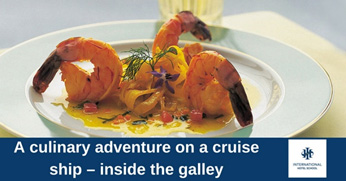

Many graduates from our culinary arts programmes choose to find work on board cruise liners for a number of reasons. In this blog, we’ll explore what it’s really like to work in the galley of a massive cruise liner, and why it’s worth all the effort to get on board with a career in culinary arts.
 Cruise liners are floating hotels that offer extreme luxury and decadence to a host of travellers for a set period of time. Whilst many of the working conditions on board a cruise ship are similar to those of a land hotel, there are a few differences when you work at sea. Whether you’re a chef, housekeeper, spa therapist or a waiter, working long hours in small spaces is definitely the norm on a cruise liner. You have to take the good with the bad, though – remember that on the plus side, you don’t have to travel to and from work every day, you are guaranteed a clean uniform and delicious meals daily, and you certainly get to travel, explore and make new friends.
Realistically though, there are also challenges when you work in a kitchen at sea. First of all, there are a number of different nationalities to work with, so language barriers can be a challenge. A good phrase book and plenty of patience will help you through those communication bumps. Also, ordering the right quantities of food can be another struggle on board as orders are placed once a week or in-between cruises…not on a daily basis. For example, if you haven’t ordered enough eggs for breakfast for the duration of your time at sea, you’d better have a creative alternative to your egg dishes as there is no chance you will be able to sail into port to stock up on eggs.
 Recipes are always provided in the galley, so young chefs have the opportunity of learning new recipe ideas and skills, whilst more experienced chefs are able to perfect recipes and add a twist or two to classic dishes (when allowed to by the head chef). You will not only learn new and exquisite recipes from around the world, you will also have the chance to learn garnishing techniques and plating skills when you spend time working long hours in the kitchen at sea. Another benefit to working in a ship’s galley is the chance to use modern kitchen equipment (used to help prepare mass meals) that you may not always have access to in hotels or certainly in smaller hotel establishments. There’s so much you can learn at sea as a chef – and with long days in the kitchen, there’s plenty of time to improve skills, swap ideas, learn new techniques and master difficult dishes you wouldn’t normally have the time to do back home.
Then there’s the fact that most cruise ships cater 24 hours a day, so it’s important to keep buffets refreshed and replenished appropriately, and master the art of cooking top quality meals in small batches, or large quantities, depending on the time of day and number of guests you’re expecting. This is vital for learning about the balance between orders, time, prep, cooking and delivery of food. If you are cooking in an a la carte kitchen, expect to enjoy a total buzz between the kitchen staff, guests and waiters. There’s an enormous amount of time set aside for the preparation of the meal before such a dinner or event, and then the actual kitchen service is totally frenetic, but organised. Ask any cruise chef – it’s all hands on deck in the kitchen. Quality, precision, creativity, timing…all these skills play a role in perfecting five-star cuisine on board some of the world’s most luxurious cruise liners.
Many guests wait a lifetime to enjoy such decadence, so being part of a chef brigade that prepares and cooks these meals is a real privilege. In this short video clip, we take a look at exactly what happens in the galley of a cruise liner through the eyes of a Head Chef:
International Hotel School offers a range of culinary arts programmes, with campuses located in Johannesburg, Cape Town and Durban, and traineeships available nationally. Our intensive one-year culinary arts programme provides students with both the theory and practical cookery skills needed to pursue a career in the field of Professional Cookery. Our Work Integrated Learning (practical) which takes place at leading hospitality establishments is what sets us apart from our competitors. For the duration of their programme, students will spend 50% of the programme on the campus covering the academic curriculum and 50% of the programme in industry. When students leave the programme, they are job ready, and that include being cruise-ready.
At International Hotel School, we are proud to have a number of cruise ship recruitment companies interview our students and graduates throughout their studies with us, and we have an enviable success rate when it comes to our chef graduates being offered cruise ship employment. If you would like to know more about our culinary courses, email info@dev.brokenpony.club for more information, or visit our website, Facebook or Instagram pages for inspiration.
(Sources and images: http://www.cruisecritic.com/blog/index.php/2013/11/07/wining-dining-the-truth-behind-cooking-on-cruise-ships/; http://www.huffingtonpost.com/franco-lania/cooking-at-sea-employment_b_4221269.html; www.pcurtis.com; http://www.crystalcruises.com/experience/ships#0407; https://www.facebook.com/PrincessCruises)
