
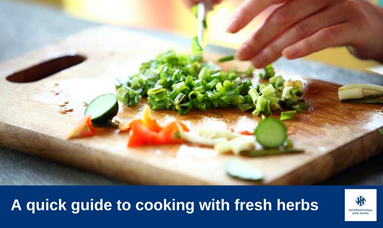

Our culinary arts students love to make use of herbs and spices to season and enhance the flavours in their cooking. Herbs, in particular, are also useful for complementing flavours and often bring out the natural flavours of the ingredients being used in the cooking process. They also add colour and texture making them a very useful part of any cooking process.
There’s no definitive answer to this question other than to say it comes down to personal preference. Dried herbs are often more robust in flavour and as a result, you may use less to achieve the results you would with fresh herbs. Dried herbs do lose their flavour over time and should be replaced annually. Fresh herbs offer a softer flavouring during the cooking process, although this flavouring can be lost if you are cooking something for longer than 45 minutes. A combination of both fresh and dried herbs is always a good idea.
If you’re able to grow your own herbs, you will reap the benefits of picking the herbs moments before using them as this allows the flavours and nutrients to last just that little bit longer. If you’re using store-bought herbs, purchase the ones that look and smell the freshest (smell is a good indicator of freshness and so is checking the colour of the herbs). Once back home, trim off the ends of the stems of any herbs, wrap the stems with a wet paper towel and place in a sealed airtight bag (with a little air in it) in your fridge until you are ready to use them. Don’t clean the herbs ahead of time as you may end up bruising them. Only wash them moments before you use them in your cooking.

With the exception of only a few hardy herbs (like rosemary or bay leaves), many herbs need to be chopped before use. Make sure you use a sharp knife when you finely chop your herbs to ensure that the oils in the herbs are released which will help to intensify the flavours. For lovely blended flavours, add your herbs at the start of your cooking. For more distinctive flavours, add your herbs near the end of the cooking process.
When using hardy herbs, simply bruise or crush the herbs with your fingers before placing into the dish. This will help the oils to release during the cooking process. Bay leaves are easy to remove after the cooking process however some herbs are not as easy. When you’re using a number of smaller herbs, try a bouquet garni to assist you with retrieving the herbs after cooking. It’s a muslin sack that can be tied around a small group of herbs and removed after cooking, making the process easier. It also allows you to control the flavours as you can remove the bouquet garni at any time during the cooking process.
Bay – Bay leaves are difficult to find fresh however they are great for flavouring soups, stocks, sauces, stews and even potatoes. They are added at the beginning of the cooking process and removed afterwards.
Dill – Fresh dill is usually easy to find and is related to the celery and fennel families. It is usually paired with fish dishes and should be added at the beginning of the cooking process. Dill is also valuable for flavouring dressings, creams and yoghurts which may be used as accompaniments to other dishes.
Rosemary – whilst we adore this hardy herb for the robust flavours it brings to lamb, pork and marinades, we recommend you use it sparingly so that it doesn’t overpower your dish or recipe.
Basil – Perfect in salads as a raw ingredient or used to flavour pasta sauces, egg dishes or chicken dishes, basil should be added at the end of the cooking process to increase the flavour intensity of a dish.
Thyme – perfect in a bouquet garni to flavour soups, stews or stuffing’s, thyme has a mild sweet flavour and should be added at the beginning of the cooking process.
If you have any questions for our culinary arts students or you would like to know more about our culinary courses, drop us a line in the comments section below – we would love to hear from you.
(Sources and images: http://www.instructables.com/id/How-to-use-herbs-and-spices-in-cooking/; http://www.foodnetwork.com/recipes/articles/guide-to-fresh-herbs.html; http://www.spiceadvice.com/newsa/usage/adding.html; http://www.urbancultivator.net/cooking-with-fresh-herbs/)
