
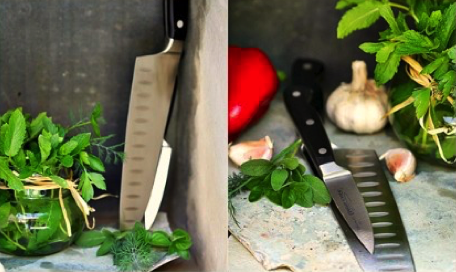
Choosing a kitchen knife is a serious business. There are so many different knives to choose from, so which one do you pick? How do you use your knife correctly? How to you clean and store your knives when you’ve finished using them? Here are our simple and easy knife tips:
What sort of knife should I use?
The four most commonly used knives are the chef’s knife, the paring knife, a utility knife and a bread knife. But there are so many others knives you may also want to consider. Some are speciality knives such as a deboning knife for filleting and deboning fish, a meat cleaver which is used for meat cuts that have to penetrate through thick skin and bone, carving knives which are essential for carving up the family Sunday roast, palette knives which are helpful in spreading the icing over a birthday cake smoothly and so on. It’s really hard to say which sort of knife you will need most but this diagram from chasingdelicious.com is very helpful so take a look and take your pick:
Rules for handling, storing and cleaning your knives:
- Your knife must be sharp. In fact, it’s paramount to your safety. Simply put, you apply extra pressure to dull knives which may slip out of your hand and cause an even deeper cut or severe laceration. You should only apply gentle pressure when cutting so that you’re less likely to cut deep into the knife if your hand does slip.
- Cutting or chopping requires considerable control. You must place your whole hand around the knife handle as you will need absolute control when you cut. Avoid holding the handle too far away from the blade, or even worse, holding the top of the blade as you cut.
- When you’re holding the item to be chopped, don’t place your thumb in the way (it’s a common mistake) rather keep your thumb wrapped under the object being chopped. If you allow your thumb to stick out, your risk of slicing off the tip is quite high and frankly, quite common. Eish!
- If you’re cutting horizontally, place your free hand on TOP of the product and your cutting hand in a firm grip on the knife handle. Move the knife slowly backwards and forwards until your layers (such as slicing a cake) are cut through. Go as slowly as possible and remember that practice makes perfect. If you leave your hand on the side of the cake whilst you are slicing horizontally, you’re likely to cut your hand.
- So basically, cutting can be summed up as follows: watch where your fingers are and watch what it is that you’re cutting, and make sure you don’t mix them up.
- Also, you should always cut your food item on a chopping board (safety and hygiene are both good reasons to do so). You don’t want the item to slip whilst you’re in the middle of chopping or slicing, so even if your knife skills are great, your cutting surface may not be and this can cause a nasty cut.
- Sharpen your knives each time you are about to use them. Use a steel to get the perfect effect. This keeps the knife edge straight and sharp. There are many techniques to sharpening. Take a look at this short clip from Gordon Ramsay:
- You can of course also sharpen your knives on a sharpening stone. Keep the blade at a 20% angle to the stone and move the edge of the blade from the heel (base) to the top, then repeat on the other side.
- Wash the knife carefully in warm and soapy water, but DO NOT stick it in the dishwasher as is can dull the blade.
- Store your knives in your knife roll. Leaving them with the rest of the cutlery in the draw can be hazardous to you and it can cause the blades to become dull.
Before you get slicing and dicing, here is one last video clip showing the different types of cutting techniques and knife safety. Have a look and let us know if you have any questions for our culinary arts students on knife skills – we would love to answer your questions.
Image Credits:
- Image credit 1: www.passionateaboutbaking.com
- Image credit 2: http://chasingdelicious.com/kitchen-101-knives-basic-cuts/#types